
Why Your E-Commerce Sales Don't Match Your Bank Deposits
Your e-commerce sales are up, but your bank deposits don't seem to match?
This is a common issue for Shopify, Amazon, eBay, and other e-commerce businesses.
The good news is that a difference between your sales and your bank deposits does not necessarily mean something is wrong. Payment processing fees, refunds, payout timing, reserves, and other transactions can all affect the amount that actually reaches your bank account.
Understanding how these transactions flow is essential for accurate bookkeeping and financial reporting.
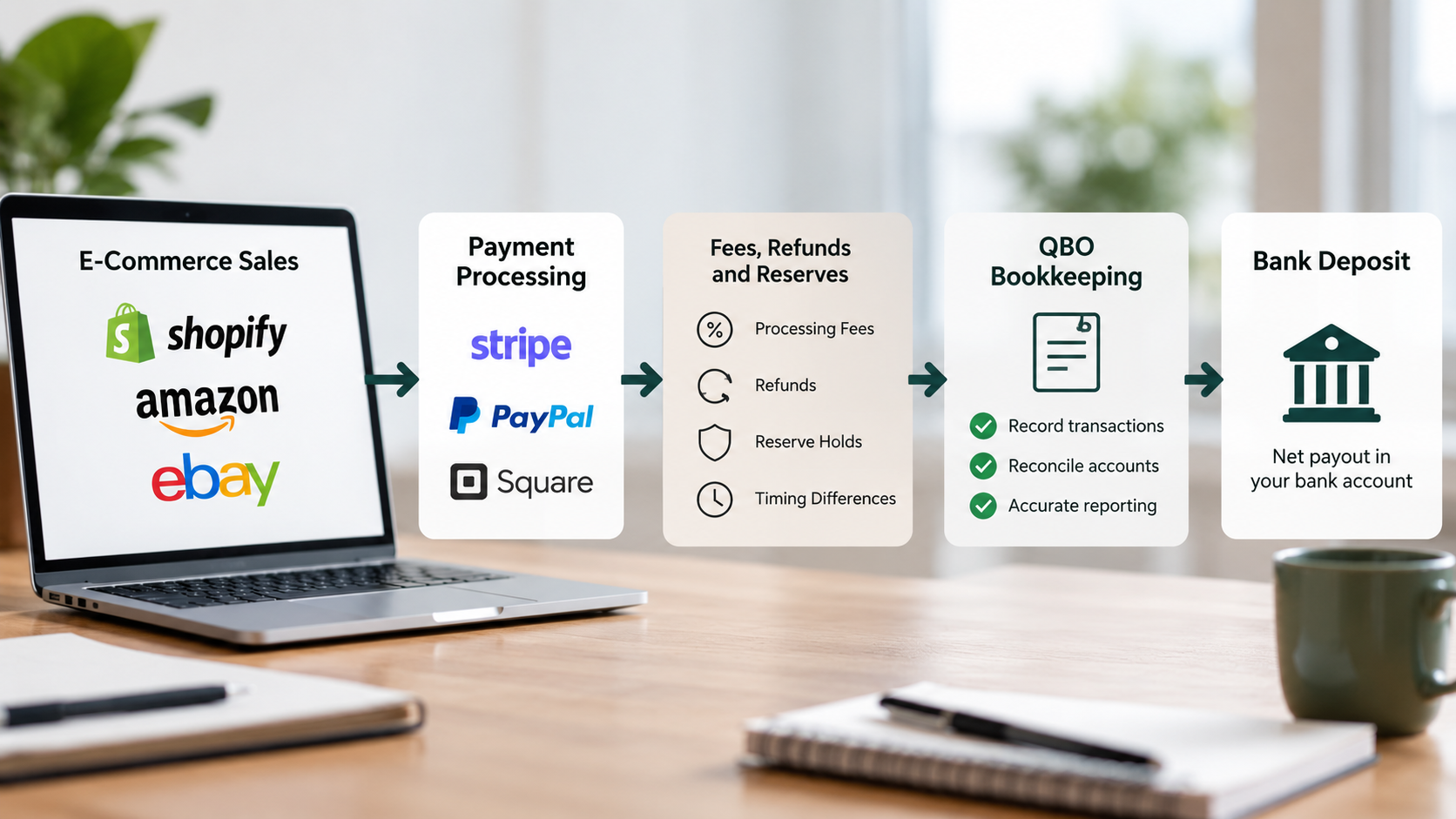
The Short Answer
Your e-commerce sales and your bank deposits are usually not supposed to be the same number.
Your sales report shows sales activity, while your bank account shows the amount actually deposited after fees, refunds, reserves, timing differences, and other adjustments.
The key to accurate bookkeeping is understanding how each platform moves money from the customer to your bank account.
Your Bank Deposit Is Not Your Sales Report
Your sales report shows what customers purchased. Your bank account shows what actually reached your account.
Those two numbers can be different because money may be deducted, held, refunded, or paid out on a different schedule before it reaches your bank.
For example, if customers purchase $10,000 of products, you might not receive a $10,000 bank deposit. Payment processing fees may be deducted, refunds may reduce the payout, and the platform may hold part of the funds in reserve.
The important point is this: your bank deposit is a cash movement, not necessarily your gross sales figure.
Payment Processing Fees Come Out Before You See the Money
When a customer pays through Shopify, Amazon, eBay, Stripe, PayPal, or another payment processor, the platform may deduct processing fees before sending the remaining amount to your bank.
For example, if you make $1,000 in sales and the payment processor deducts $30 in fees, your bank may receive $970 instead of $1,000.
Your bookkeeping should record the sales and processing fees separately. This allows your financial statements to show gross sales separately from the payment processing fees associated with those sales.
This is one of the most common reasons e-commerce business owners wonder why their sales report doesn't match their bank deposits.
Your Sales and Your Payout May Belong to Different Dates
E-commerce platforms don't always send your money to the bank on the same day the sale occurs.
A customer might place an order on Monday, the payment may be processed on Monday or Tuesday, and the payout may not reach your bank until Wednesday or later.
This creates timing differences between your sales reports and your bank activity.
For example, if your e-commerce platform reports $5,000 in sales during the last few days of the month, some of those sales may not appear as bank deposits until the following month.
This is why comparing your monthly sales directly to your monthly bank deposits can create misleading results.
Refunds and Chargebacks Change What You Actually Receive
Refunds and chargebacks can also create differences between your sales and your bank deposits.
A sale may appear in your sales report when the customer places the order, but a refund processed later can reduce a future payout or appear as a separate transaction.
Chargebacks work similarly. A payment may initially be included in your sales, but the amount can later be withdrawn from your account when a customer disputes the transaction.
This means you need to consider both the original sale and the related refund or chargeback when reconciling your e-commerce activity.
Platform Reserves and Holds Can Tie Up Your Cash
Some e-commerce platforms temporarily hold a portion of your funds as a reserve or payment hold.
That money may be owed to your business, but it may not be available for withdrawal until the platform releases the reserve or hold. As a result, your sales report can show revenue even though the related cash has not reached your bank account.
For example, a platform might hold $1,000 in reserve and release it later. Your bank deposit for the current period would therefore be lower than the sales reported by the platform.
When reconciling your accounts, it's important to identify these held funds rather than treating them as missing deposits.
Your Bank Account Is Also Paying for Everything Else
Your bank account doesn't only receive money from your e-commerce platform. It may also be used to pay for advertising, software subscriptions, shipping, inventory, contractors, refunds, and other business expenses.
These transactions can make your bank activity look very different from your sales activity.
For example, you might receive a $5,000 e-commerce payout and then pay $1,200 of business expenses from the same bank account. Your ending bank balance will reflect both the incoming payout and the outgoing expenses, so it should not be used as a direct measure of your e-commerce sales.
This is why your bank balance, bank deposits, and e-commerce sales should be reviewed separately when analyzing your business finances.
What You Should Check When Sales Don't Match Your Bank Deposits
When your e-commerce sales don't match your bank deposits, check these items before assuming there is an error:
Gross sales — Compare the platform's gross sales with your bookkeeping records.
Payment processing fees — Check whether fees were deducted before the payout reached your bank.
Refunds and chargebacks — Look for refunds, disputes, and other adjustments.
Payout timing — Check whether sales from the end of the month were deposited in the following month.
Reserves and holds — Identify funds that the platform has temporarily withheld.
Taxes and other deductions — Check whether sales tax or marketplace-collected taxes are being handled separately from your sales and payouts.
Other transactions — Review transfers, adjustments, and business expenses affecting the bank account.
Clearing accounts — Make sure payments moving through platforms such as Shopify, Amazon, eBay, Stripe, or PayPal are properly reconciled.
A proper reconciliation should explain the difference between your reported sales and the cash that actually reached your bank.
The Difference Usually Has an Explanation
When your e-commerce sales don't match your bank deposits, the difference usually comes from how the platform processes, holds, adjusts, and pays out your money.
Instead of trying to force your sales report to match your bank deposits, reconcile the transactions that connect the two.
A properly organized bookkeeping system should allow you to trace your sales from the e-commerce platform through payment processing and clearing accounts to the final bank deposit.
This gives you a clearer picture of your actual revenue, fees, refunds, and cash flow.
For e-commerce businesses, accurate reconciliation is not just about making two numbers match. It's about understanding why they are different and making sure every difference is properly accounted for.
Need Help Reconciling Your E-Commerce Sales?
If your Shopify, Amazon, eBay, Stripe, or PayPal sales don't match your bank deposits, Ellance Solutions can help you reconcile the transactions and identify what's causing the difference.
